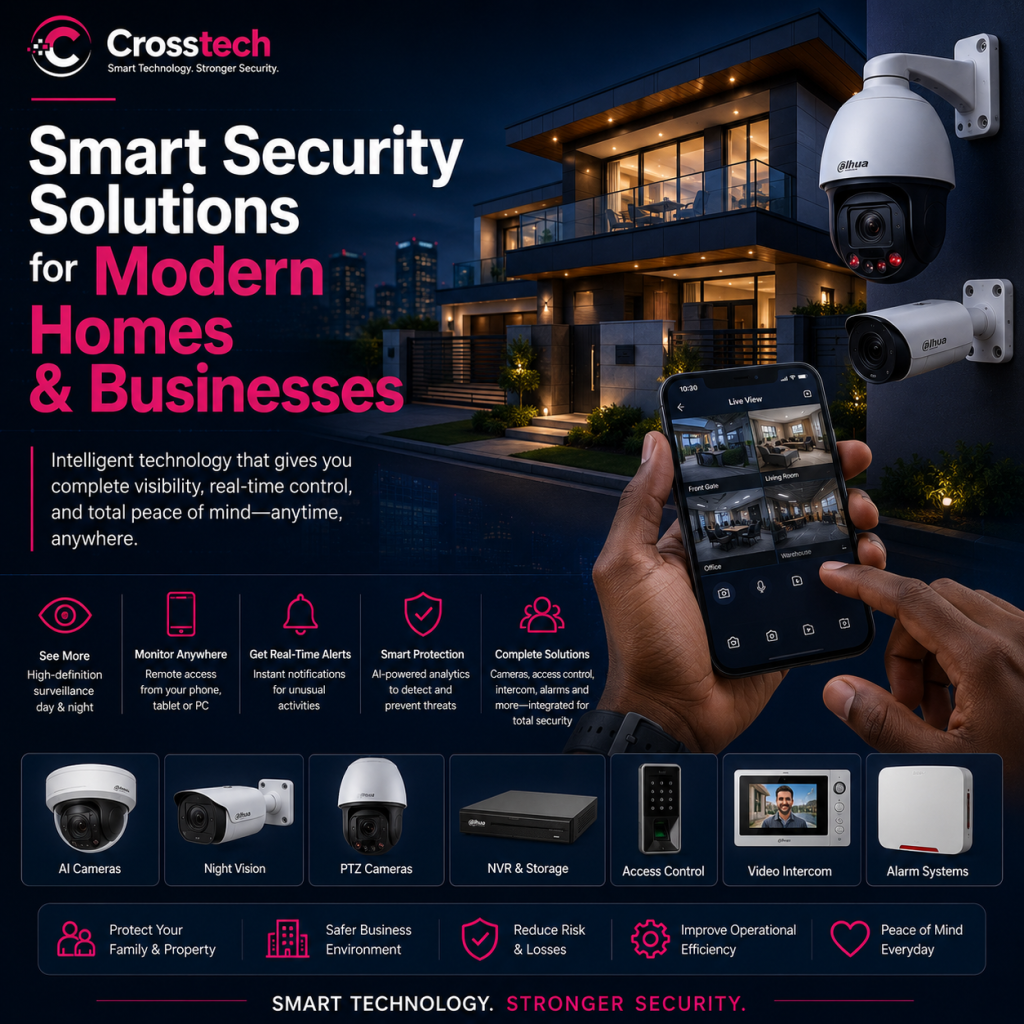
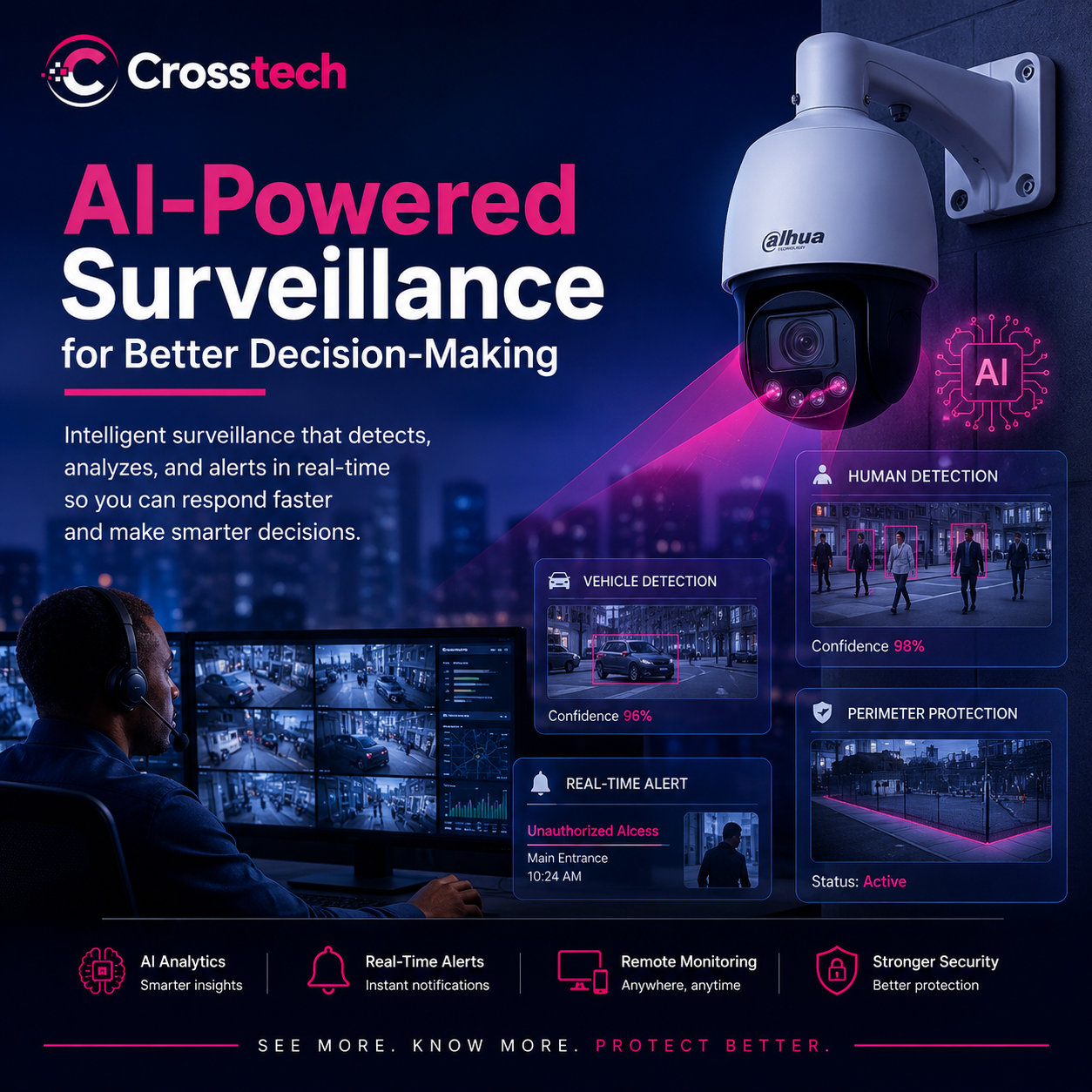
One of the most significant developments in business security is the use of artificial intelligence.
Large organizations can have dozens or even hundreds of cameras installed across their facilities.
It is impossible for a security officer to watch every camera continuously.
AI-powered surveillance can help reduce this challenge by assisting with the identification of relevant activities.
For example, intelligent surveillance technology can help distinguish between different types of movement and identify events that may require attention.
Depending on the system and configuration, AI-enabled cameras may support:
- Human detection
- Vehicle recognition
- Perimeter intrusion detection
- Object monitoring
- Smart tracking
- Crowd monitoring
- Behaviour analysis
- Event-based alerts
This allows security teams to focus on important events instead of manually watching hours of video footage.
For businesses, this can improve operational efficiency and reduce the time required to investigate security incidents.
Protecting Business Premises 24 Hours a Day
Businesses do not stop being vulnerable when employees leave the office.
In fact, many properties face greater risks outside normal working hours.
Warehouses, offices, retail stores, industrial facilities, and construction sites may be particularly vulnerable during the night.
Modern surveillance systems provide continuous monitoring capabilities designed to operate in different lighting conditions.
Advanced camera technologies can support:
- Infrared night vision
- Low-light monitoring
- Smart illumination
- Colour imaging in low-light environments
- Wide dynamic range
This allows businesses to maintain better visibility across important areas regardless of the time of day.
However, effective night-time surveillance depends on more than camera specifications.
Proper camera positioning, environmental lighting, coverage planning, and system configuration are equally important.
Access Control and Visitor Management
Security cameras allow businesses to see what is happening.
Access control systems help businesses manage who is allowed to enter.
This is particularly important for organizations with restricted areas.
Examples may include:
- Executive offices
- Server rooms
- Data centres
- Financial departments
- Warehouses
- Research facilities
- Inventory storage areas
- Production facilities
Traditional keys can be difficult to manage.
They can be lost, copied, or shared without authorization.
Modern access control systems provide organizations with greater flexibility.
Businesses can use technologies such as:
- Access cards
- PIN codes
- Biometric authentication
- Facial recognition
- Mobile credentials
Access permissions can also be assigned based on an individual’s role.
For example, an employee may have access to the general office but not to sensitive technical or financial areas.
This helps businesses create a more structured approach to physical access management.
Improving Security Across Multiple Business Locations
Many businesses operate from more than one location.
A company may have:
- A head office
- Multiple branch offices
- Retail outlets
- Warehouses
- Manufacturing facilities
- Distribution centres
Managing security independently at every location can be challenging.
Modern security technology allows authorized users to centralize monitoring and maintain visibility across multiple sites.
A security manager can potentially monitor different locations from a central control environment.
This can improve consistency in security operations and reduce the need to manage each location separately.
Remote monitoring is particularly valuable for business owners and facility managers who need to maintain visibility while travelling or working from another location.
Smart Security for Retail Businesses
Retail businesses face unique security challenges.
They must protect products, employees, customers, and cash-handling areas while maintaining a welcoming environment.
Security solutions for retail environments may include:
- Indoor surveillance cameras
- Entrance monitoring
- Cashier area cameras
- Stockroom surveillance
- Parking area monitoring
- Access control
- Video analytics
The goal is not simply to prevent theft.
A well-designed surveillance system can also help businesses investigate incidents, monitor important areas, and improve overall situational awareness.
For businesses with multiple stores, centralized monitoring can help management maintain visibility across different locations.
Security Solutions for Warehouses and Industrial Facilities
Warehouses and industrial facilities often cover large physical areas.
They may contain valuable equipment, inventory, machinery, and vehicles.
These environments may require a combination of different security technologies.
A comprehensive solution could include:
- Perimeter surveillance
- PTZ cameras
- Fixed surveillance cameras
- Access control systems
- Intrusion detection
- Remote monitoring
- Centralized video management
- Secure video storage
PTZ cameras can be particularly useful in large facilities because they provide flexible monitoring capabilities.
They can pan across wide areas, tilt to monitor different locations, and zoom in when additional detail is required.
Perimeter protection is also important for warehouses and industrial facilities.
The ability to monitor gates, fences, loading areas, and external storage locations can help businesses maintain better awareness of activities around their property.
Security for Corporate Offices
Corporate offices require a balance between security and convenience.
Employees, visitors, contractors, and service providers may enter and leave the building throughout the day.
Businesses need systems that provide security without creating unnecessary barriers to normal operations.
Smart office security solutions can include:
- Reception monitoring
- Visitor management
- Access control
- Video intercom systems
- Indoor surveillance
- Parking area monitoring
- Server room protection
A video intercom system can help reception teams verify visitors before granting access.
Access control can help manage employee access to specific departments or restricted areas.
Surveillance systems can provide visibility across entrances, common areas, and important operational spaces.
Together, these technologies can create a more structured and secure office environment.
The Importance of Video Storage and Retrieval
A security system is only as useful as the information it can provide when needed.
Businesses should carefully consider their video storage requirements.
Factors to consider include:
- Number of cameras
- Video resolution
- Recording duration
- Frame rate
- Storage capacity
- Backup requirements
- Retention policies
Network Video Recorders and other storage solutions allow businesses to manage and store surveillance footage.
Modern systems can also make it easier to search and retrieve relevant recordings.
Instead of manually reviewing hours of footage, intelligent search capabilities can help security teams locate specific events more efficiently.
This can be particularly important during investigations.
Integrating Security Technologies Into One Ecosystem
One of the biggest advantages of smart security is integration.
Businesses should avoid thinking about security devices as isolated products.
A surveillance camera, access control system, alarm system, and video intercom can provide greater value when they are designed to work together.
For example, an integrated security environment may allow:
- Cameras to monitor access points
- Access control systems to manage entry
- Video intercoms to verify visitors
- Alarm systems to trigger security notifications
- Centralized software to manage multiple devices
This creates a more connected security ecosystem.
Instead of managing several independent systems, businesses can create a coordinated security infrastructure.
Scalability: Planning for Business Growth
Businesses change.
A small company may open new offices.
A retailer may expand into new locations.
A warehouse may increase its storage capacity.
Security systems should be designed with future growth in mind.
A scalable solution allows organizations to add:
- More cameras
- Additional access control points
- New storage capacity
- Additional monitoring locations
- New facilities
without completely replacing the existing infrastructure.
Planning for scalability can help businesses protect their technology investment and reduce future implementation costs.
The Role of Professional Security Planning
Installing security equipment without proper planning can create gaps.
For example, a camera may have excellent technical specifications but still fail to capture an important area because it was installed in the wrong location.
Professional security planning should begin with understanding the environment.
Important considerations include:
Site Assessment
Understanding the physical layout and identifying potential security risks.
Coverage Planning
Determining where cameras should be installed and what areas require monitoring.
Access Management
Identifying restricted areas and determining who should have access.
Network Infrastructure
Ensuring that the network can support security devices and video transmission.
Storage Requirements
Planning sufficient capacity for video recording and retention.
Future Expansion
Ensuring the solution can grow as the business expands.
The objective is not simply to install more equipment.
The objective is to create a security solution that provides meaningful protection.
Building a Smarter and More Secure Business
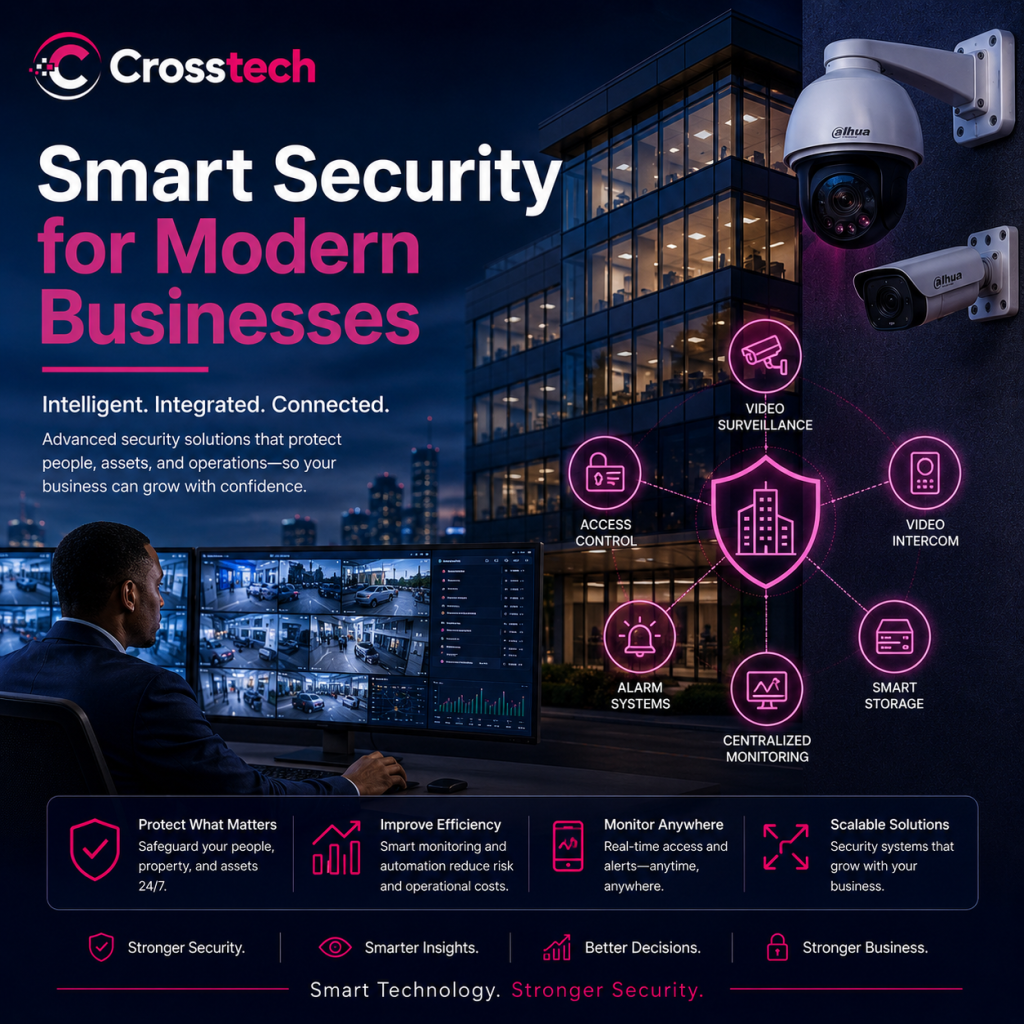
Modern business security requires a broader approach.
A reliable security strategy should combine the right technology, professional planning, and ongoing management.
The most effective security environments typically combine several layers of protection.
These may include:
- Intelligent surveillance
- Access control
- Visitor management
- Remote monitoring
- Alarm systems
- Secure video storage
- Network infrastructure
- Centralized management
Each component plays a role in helping businesses maintain greater awareness and control.
The result is not simply a collection of security devices.
It is a connected security ecosystem designed around the needs of the organization.
Crosstech: Supporting Smarter Business Security
At Crosstech, we understand that every business has unique security requirements.
A retail store does not have the same security needs as a warehouse.
A corporate office requires a different approach from a manufacturing facility.
That is why effective security begins with understanding the environment.
Crosstech helps businesses explore modern security technologies designed to improve visibility, manage access, and support more efficient security operations.
From intelligent surveillance cameras and PTZ systems to access control, video intercoms, storage solutions, and integrated security infrastructure, we help organizations build security environments that are smarter, more connected, and ready for the future.
Because in today’s business environment, security should do more than capture footage.
It should provide insight.
It should improve awareness.
It should support faster response.
And it should help businesses protect the people, assets, and operations that matter most.